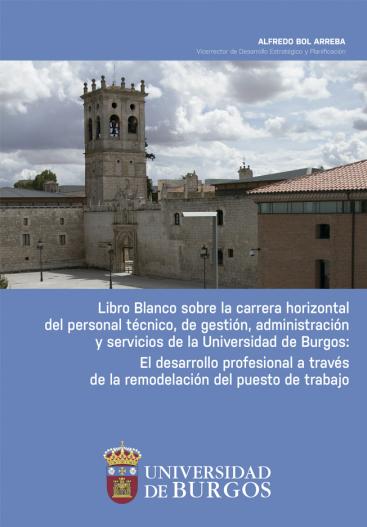
Libro Blanco sobre la carrera horizontal del personal técnico, de gestión y de administración y servicios de la Universidad de Burgos: el desarrollo profesional a través de la remodelación del puesto de trabajo
Keywords:
horizontal career, professional, university management, human resources, job crafting, performance evaluation, public service, organizational changeSynopsis
The White Paper on Horizontal Career Development for Technical, Management, Administrative, and Service Staff (PTGAS) at the University of Burgos introduces an innovative model to recognize professional growth without requiring job changes or waiting for vacancies. Based on the legal framework of Spain’s Basic Statute of Public Employees (EBEP) and research on job crafting (active job redesign), the document offers an alternative to traditional vertical promotion, which is often limited and dependent on external factors.
The text highlights structural challenges in public administration, such as the tension between individual expectations and organizational rigidity, the scarcity of promotion opportunities, and risks linked to generational turnover. Horizontal career progression emerges as a solution that enables advancement within the same position, grounded in merit, performance, initiative, and institutional commitment.
The model is structured into five progressive stages (from “Consolidated Professional” to “Professional of Excellence”), achieved through voluntary evaluation and objective evidence. Each stage includes a consolidated financial incentive and additional benefits, such as priority access to advanced training and participation in strategic projects. Evaluations will be conducted by an external Technical Commission to ensure transparency and fairness, supported by institutional monitoring mechanisms.
A key component of the model is job crafting, defined as the employee’s ability to redesign tasks, relationships, and perceptions to enhance meaning and motivation at work. This approach positions horizontal career development as a cultural transformation tool, fostering responsible autonomy and continuous improvement. The Job Crafting Questionnaire (JCQ) will be used to assess organizational readiness and measure the model’s impact over time. Implementation will occur in phases: regulatory design, an initial exceptional call, and subsequent regular calls, accompanied by training, communication, and evidence-gathering systems. The ultimate goal is to build an institutional culture that values quality work, encourages engagement, and prepares the University for challenges such as digitalization and generational renewal.
In short, this White Paper is not merely a technical proposal but a strategic commitment to a more cohesive, motivated, and service-oriented university.
Downloads
Abstract 658
References
Berg, J. M., Dutton, J. E., & Wrzesniewski, A. (2013). Job crafting and meaningful work. In B. J. Dik, Z. S. Byrne, & M. F. Steger (Eds.), Purpose and meaning in the workplace (pp. 81–104). American Psychological Association. https://doi.org/10.1037/14183-005
Constantini, A., Demerouti, E., Ceschi, A., & Sartori, R. (2021). Job crafting: Conceptualization, measurement, and outcomes. In A. Ceschi & C. Vandeweerdt (Eds.), Job crafting: Advances in theory, research, and practice (pp. 11–25). Routledge.
Gorriti Bontigui, M. (2024). La carrera horizontal en la Administraciones Públicas desde los recursos humanos: el Job crafting. Revista Vasca de Gestión de Personas y Organizaciones Públicas, (27), 8–25. https://doi.org/10.47623/ivap-rvgp.27.2024.01
Instituto Nacional de Administración Pública. (2020). La carrera profesional en la Administración Pública Española. INAP.
Junça Silva, A., Caetano, A., & Rueff, R. (2023). Daily work engagement is a process through which daily micro-events at work influence life satisfaction. International Journal of Manpower, 44(7), 1288–1306. https://doi.org/10.1108/IJM-05-2022-0214
Letona-Ibañez, O., Carrasco, M., Martínez-Rodríguez, S., Amillano, A., & Ortiz-Marqués, N. (2019). Cognitive, relational and task crafting: Spanish adaptation and analysis of psychometric properties of the Job Crafting Questionnaire. PLoS ONE, 14(10), Article e0223539. https://doi.org/10.1371/journal.pone.0223539
Letona-Ibañez, O., Martínez-Rodríguez, S., Carrasco-Gallego, A., & León-Del-Barco, B. (2019). The effect of job crafting on work engagement and well-being outcomes: A structural modelling approach. Journal of Work and Organizational Psychology, 35(3), 135–143. https://doi.org/10.5093/jwop2019a15
Real Decreto Legislativo 5/2015, de 30 de octubre, por el que se aprueba el Texto Refundido del Estatuto Básico del Empleado Público. Boletín Oficial del Estado, 261, 103278–103333. https://www.boe.es/eli/es/rdlg/2015/10/30/5/con
Slemp, G. R., & Vella-Brodrick, D. A. (2013). The Job Crafting Questionnaire: A new scale to measure the extent to which employees engage in job crafting. International Journal of Wellbeing, 3(2), 126–146.
Wrzesniewski, A., & Dutton, J. E. (2001). Crafting a job: Revisioning employees as active crafters of their work. The Academy of Management Review, 26(2), 179–201. https://doi.org/10.5465/amr.2001.4378011
Published
Categories
License

This work is licensed under a Creative Commons Attribution-NonCommercial-NoDerivatives 4.0 International License.